
Stuffed Pepperoni Pizza Roll (Italian Stromboli)
Stuffed Pepperoni Pizza Roll (Italian Stromboli): Golden, Cheesy, and Impossible to Resist
There’s a moment, somewhere around the third or fourth slice of a well-made stromboli, when you realize that pizza has been holding out on you. All those years of topping-scattered flatbread, of crust that holds the filling up rather than wrapping around it — and this whole time, you could have been eating pizza dough rolled around layers of pepperoni and salami and mozzarella and ham until they melted together into something unified, dense, and extraordinary. A stromboli is what happens when you decide the crust should contain the filling entirely, turning every bite into an equal distribution of golden-baked dough, gooey cheese, and seasoned Italian meat with none of the topping-sliding and structural compromise of a regular slice.
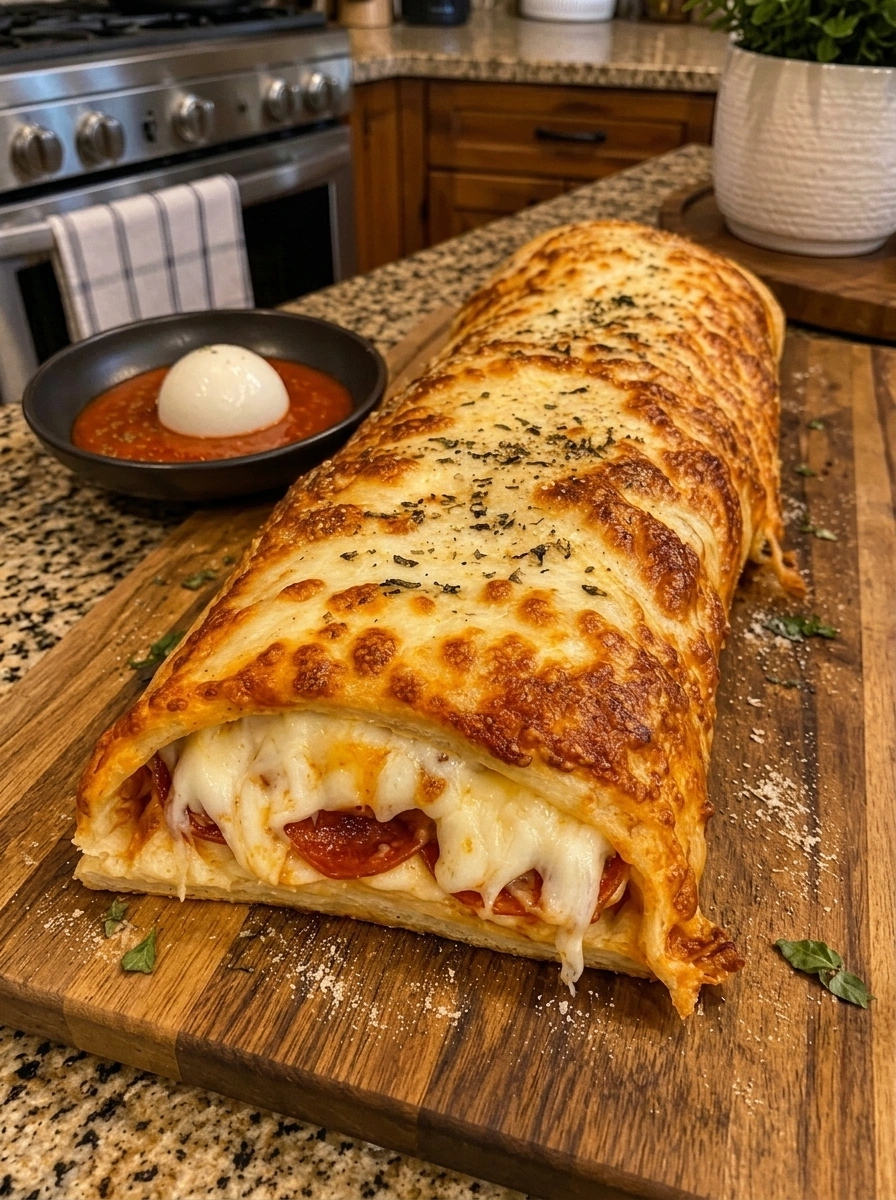
This Stuffed Pepperoni Pizza Roll is the definitive version: pizza dough rolled out and layered with pizza sauce, two kinds of cheese, pepperoni, Genoa salami, and ham, then tightly rolled into a log and baked until deeply golden and crispy on the outside with a molten, cheesy interior. The finishing move — a garlic butter brush loaded with minced garlic, Italian seasoning, olive oil, and Parmesan — takes the crust from good to the kind of thing people eat as they carry the pan to the table before anyone else can get there.
One slice, warm from the oven, pulled open to reveal that stretchy mozzarella interior, and you’ll understand immediately why this becomes the game day request, the party contribution that people ask for by name, the Friday night dinner that the whole family circles back to again and again.
This guide covers everything: the history and distinction between stromboli and calzone, the techniques that make the difference between a good stromboli and a great one, a complete ingredient breakdown, step-by-step instructions with technique detail, and every serving and storage note you need.
Stromboli vs. Calzone: What’s Actually the Difference?
Few culinary distinctions inspire as much passionate debate as the difference between stromboli and calzone, and it’s worth settling the question clearly — particularly because this recipe is specifically a stromboli and the distinction matters for technique.
Calzone is an Italian dish with genuine Italian roots — it originates in Naples, the same city that gave the world Neapolitan pizza. A calzone is made by folding a round of pizza dough in half over a filling, creating a half-moon or turnover shape. The dough is sealed at the edges and baked until golden. Individual-sized calzones are common; they’re a personal pizza folded over itself.
Stromboli is an Italian-American creation with a much more specific and recent origin. It was invented — or at least popularized — in the Philadelphia area in the early 1950s, with Romano’s Italian Restaurant in Essington, Pennsylvania, often cited as the originator. Named for the volcanic Italian island (and possibly for the 1950 Ingrid Bergman film of the same name), stromboli is made by rolling a rectangle of pizza dough around a filling — like a jelly roll or a log — rather than folding it. The result is a cylindrical shape that, when sliced, produces circular cross-sections showing the rolled layers of dough, cheese, and filling.
The rolled structure is what makes stromboli different from calzone in practice: the filling is distributed in a spiral throughout the entire log, which means every slice contains multiple layers of filling and dough rather than a single pocket. The long, cylindrical shape also makes stromboli ideal for feeding a group — one stromboli slices into eight to ten generous portions.
One more distinction: traditional stromboli typically includes Italian cured meats (salami, ham, pepperoni) rather than the ricotta cheese that’s often found in calzone. The meat-forward filling and the pizza sauce spread on the dough before rolling are characteristic of authentic stromboli.
The Dough: The Foundation Everything Depends On
No component matters more to the finished stromboli than the dough. It’s the container, the crust, and the structural element that holds everything together during the roll, the bake, and the slice.
Refrigerated Pizza Dough
Refrigerated store-bought pizza dough (the kind sold in tubes in the refrigerated section, from brands like Pillsbury) is the most convenient option and produces reliably good results. It’s already developed, elastic, and ready to roll — no waiting for yeast to activate or dough to rise.
The key with refrigerated dough: let it come to room temperature for 20 to 30 minutes before rolling. Cold dough is tight and springy and fights back against the rolling pin, shrinking every time you try to roll it out. Room-temperature dough relaxes and rolls smoothly into the 10×14-inch rectangle the recipe requires.
Fresh Pizza Dough From the Deli or Pizzeria
Many grocery stores sell fresh pizza dough balls in their deli departments, and most local pizzerias will sell dough directly if you ask. This is often the best-tasting option — the dough has been properly fermented and developed and produces a stromboli with more complex, yeasty flavor and a better texture than tube-style refrigerated dough.
Homemade Pizza Dough
If you make homemade pizza dough, a standard recipe using bread flour, water, yeast, salt, and olive oil works perfectly. A 24-hour cold ferment in the refrigerator produces the most flavorful dough. Use approximately one pound (the standard single pizza dough yield) for this recipe.
Rolling the Dough Correctly
Lightly flour your work surface before rolling. Begin from the center of the dough ball and roll outward in all directions rather than rolling back and forth in one direction, which develops uneven tension in the dough. If the dough springs back, let it rest for 5 minutes before continuing — it’s relaxing and will roll more easily. Target dimensions are approximately 10 inches wide by 14 inches long, keeping the thickness as even as possible throughout.
Uneven thickness means uneven baking — thin spots may burn while thick spots remain doughy. Take time with this step.
The Meat Trio: Why Three Cured Meats Are Better Than One
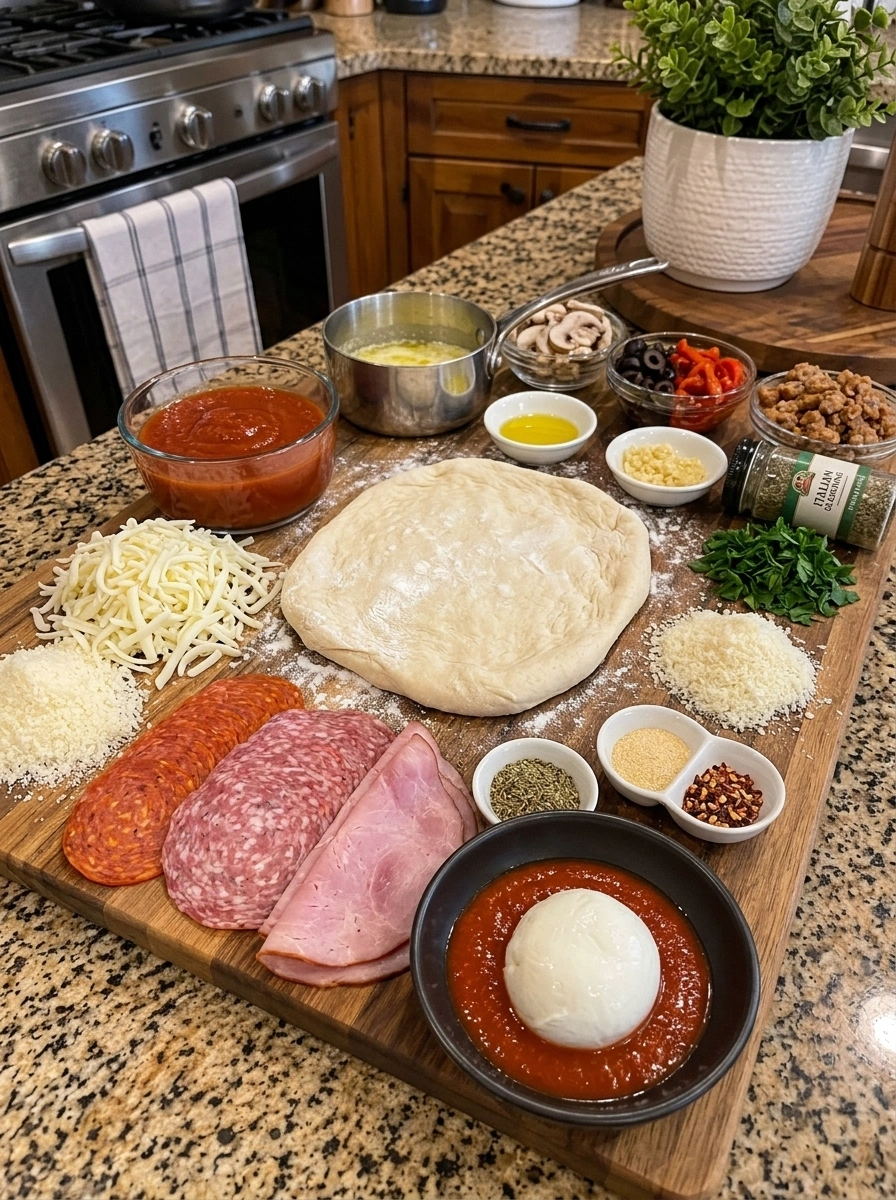
The combination of pepperoni, Genoa salami, and ham is deliberate and produces a more interesting, more complex filling than any single meat would achieve.
Pepperoni is the essential pizza meat — its slightly spicy, paprika-and-fennel-spiced, dried pork character is immediately recognizable and deeply satisfying. It’s the dominant flavor note in the filling and the meat most associated with pizza culture in the United States.
Genoa salami is an Italian dry-cured sausage with a more complex, more refined flavor than pepperoni — it’s less spicy, more richly pork-forward, with black pepper and garlic notes and a slightly firmer texture. It adds layers and sophistication to the filling that pepperoni alone doesn’t provide.
Ham adds moisture and a mild, slightly sweet cured pork flavor that counterbalances the more intense, spicier pepperoni and salami. It also adds volume and body to the filling without adding more strong flavor, creating space for the cheese and seasoning to come through between the meat layers.
Layering matters. The recipe layers the meats after half the cheese and before the remaining cheese — this means the meats are sandwiched between cheese on both sides, ensuring the fat from the cured meats bastes the surrounding cheese as it melts and renders during baking.
The Cheese Strategy: Why Whole Milk Mozzarella and Parmesan Together
The recipe uses two cheeses in a specific proportion, and both choices are deliberate.
Whole milk mozzarella provides the stretch — that quintessential pizza pull that happens when you slice a slice and the cheese stretches between the knife and the plate. Part-skim mozzarella melts into a more rubbery, less elastic texture. Pre-shredded mozzarella is coated with cellulose and starch that inhibit melting. For the best cheese pull: buy a block of whole milk low-moisture mozzarella and shred it yourself.
The recipe uses two cups total, divided between the bottom layer (over the sauce) and a second layer over the meats. This double-layer cheese strategy is important — the bottom layer melts upward into the meats, and the top layer melts downward, creating a unified, gooey cheese matrix throughout the entire filling.
Grated Parmesan adds a sharp, salty, nutty counterpoint to the mild stretch of mozzarella. Parmesan has much less moisture than mozzarella and doesn’t melt in the same way — it contributes flavor and a slightly more complex, textured quality to the filling. Always use freshly grated Parmesan rather than the pre-grated shelf-stable variety, which has a dusty, dried texture that doesn’t contribute the same richness.
The Garlic Butter: The Finishing Touch That Transforms Everything
The garlic butter topping is the detail that separates this stromboli from a basic stuffed bread, and it deserves its own attention.
Three tablespoons of melted butter create the rich, golden crust during baking — butter’s milk solids brown under oven heat and create the deep golden color and slightly caramelized exterior that makes this stromboli look as good as it tastes.
Olive oil is added to the butter for two reasons: it raises the smoke point slightly (butter can burn at high oven temperatures) and it adds its own flavor — grassy, slightly fruity — that butter alone doesn’t provide.
Three cloves of fresh minced garlic infuse the butter as it sits. Use fresh garlic rather than garlic powder — the real garlic melts slightly into the hot butter and creates a more aromatic, more pungent brush that garlic powder can’t replicate.
Italian seasoning and Parmesan on the outside of the stromboli create a seasoned, slightly textured crust — the Parmesan develops golden, slightly crispy spots during baking that are among the best bites on the entire roll.
Fresh parsley adds color and a bright herbal freshness to what would otherwise be a very rich, very brown exterior.
Brush generously. Don’t be timid with the garlic butter — apply it thoroughly to every surface of the stromboli before it goes in the oven. Any leftover butter can be applied again when the stromboli comes out of the oven for an even more pronounced garlic bread effect.
How to Make Stuffed Pepperoni Pizza Roll: Step-by-Step
Step 1: Preheat and Prepare
Preheat the oven to 400°F (205°C). Line a large rimmed baking sheet with parchment paper. Remove the pizza dough from the refrigerator and let it rest at room temperature for 20 to 30 minutes.
Step 2: Roll the Dough
Lightly flour your work surface. Roll the dough into a rectangle approximately 10 inches wide by 14 inches long, working from the center outward. Keep the thickness as even as possible. If the dough springs back, rest it for 5 minutes and resume.
Step 3: Layer the Filling
Spread the pizza sauce over the dough in a thin, even layer, leaving a 1-inch border on all four edges. The border is critical for sealing — sauce right to the edge prevents the seam from closing properly and results in filling that leaks out during baking.
Sprinkle 1 cup of the shredded mozzarella evenly over the sauce. Layer the pepperoni slices over the cheese, then the salami, then the ham. Sprinkle the remaining mozzarella and all of the Parmesan over the top of the meats. Dust with Italian seasoning, garlic powder, and red pepper flakes if using.
Don’t overfill. The temptation is to pile in more filling — resist it. Overfilled stromboli is difficult to roll, prone to tearing, and likely to burst during baking. The filling amounts in the recipe produce a generously stuffed stromboli without compromising the structural integrity.
Step 4: Roll Tightly
Starting from the long edge (the 14-inch side), begin rolling the dough away from you into a tight log. Roll firmly and consistently — a loose roll produces gaps in the filling and a stromboli that falls apart when sliced. As you roll, tuck in the short ends of the dough every few rolls to contain the filling.
When the roll is complete, pinch the seam closed firmly along the entire length. Pinch the end flaps closed as well. Place the stromboli seam-side down on the prepared baking sheet — the weight of the stromboli resting on the seam helps keep it closed during baking.
Step 5: Score and Brush
Using a sharp knife, cut 4 to 5 diagonal slits across the top of the stromboli, each about ½ inch deep. These slits allow steam from the melting cheese and releasing moisture to escape during baking, preventing the dough from becoming soggy or splitting unpredictably.
Mix the garlic butter ingredients together and brush generously over the entire surface of the stromboli — top, sides, and ends.
Step 6: Bake
Bake at 400°F for 25 to 30 minutes until the crust is deeply golden brown and visibly crispy. The internal temperature should reach 190°F to 200°F, indicating the dough is fully cooked. If the exterior is browning faster than expected, tent loosely with foil for the remaining bake time.
Step 7: Rest and Slice
Remove from the oven and let rest for 10 minutes before slicing. This rest period allows the molten cheese inside to stabilize slightly — cutting immediately produces slices that fall apart and release filling. After 10 minutes, use a serrated knife to slice into 1 to 1.5-inch rounds.
Serve immediately with pizza sauce, marinara, garlic butter, or ranch dressing for dipping.
Technique Tips for a Perfect Stromboli
Room temperature dough is non-negotiable. Cold dough tears, springs back, and produces an uneven thickness. If you’re using refrigerated dough, plan for a 30-minute counter rest before rolling.
The 1-inch border is essential. Sauce or filling all the way to the edge prevents the seam from sealing and guarantees filling leaks during baking. Keep the border clean.
Roll from the long side. Rolling from the 14-inch side rather than the 10-inch side produces a longer, slimmer stromboli with more surface area and more slices. Rolling from the short side produces a shorter, fatter stromboli with a more biscuit-like cross-section.
Seam-side down. Always. The oven’s heat will try to peel the seam open — placing it against the pan prevents this.
Score the top before baking. This is not optional. Without vents, steam from the cheese and meat builds up inside the roll and can cause the crust to bubble, crack unpredictably, or burst at the seam.
Brush the butter twice. Once before baking, once immediately after coming out of the oven. The second application produces a glossier, more aromatic exterior.
Every Way to Serve Stromboli
As a game day centerpiece. A whole stromboli on a cutting board at the center of a game day spread is a statement piece. Set out the dipping sauces — pizza sauce, marinara, garlic butter, ranch — and let people serve themselves. It holds up at room temperature for an hour without losing its appeal.
As a family dinner. Slice into generous portions and serve alongside a Caesar salad and garlic bread. This is a complete Friday night dinner that requires almost no additional preparation.
As a party appetizer. Slice thin (¾ inch) for more, smaller pieces that work as finger food. Two stromboli rolls made simultaneously and sliced thin feed a crowd of twenty comfortably.
As a packed lunch. Individual slices wrapped in foil reheat beautifully in an oven or air fryer and hold together well enough to travel. This is an exceptional school or work lunch option that’s considerably more exciting than a sandwich.
With a range of dipping sauces. Pizza sauce is the classic choice; marinara is very similar. Garlic butter makes the whole experience more indulgent. Ranch dressing is a polarizing choice that nonetheless has millions of devoted advocates. Hot honey — a drizzle of honey over a slice with a pinch of red pepper flakes — is an increasingly popular variation worth trying.
Variations
Meat Lover’s Stromboli: Add crumbled cooked Italian sausage and cooked bacon crumbles to the filling alongside the pepperoni, salami, and ham. The most indulgent, most satisfying version.
Vegetarian: Replace all the meats with sautéed mushrooms, roasted red peppers, fresh spinach, sliced black olives, and banana peppers. Season aggressively with Italian seasoning and red pepper flakes. Just as satisfying, very different character.
Buffalo Chicken: Replace the Italian meats with shredded buffalo chicken tossed in buffalo sauce. Use a combination of mozzarella and pepper jack cheese. Serve with ranch dressing. A crowd-pleasing variation that’s perfect for game day.
Four Cheese: Omit the meats entirely and fill with mozzarella, provolone, Parmesan, and ricotta, seasoned with fresh basil and black pepper. Serve with a simple tomato sauce for dipping. Lighter, more elegant, and excellent as an appetizer.
Breakfast Stromboli: Fill with scrambled eggs, cooked breakfast sausage or bacon, shredded cheddar, and diced bell pepper. Use the same dough and garlic butter topping. Serve with salsa. A weekend brunch option that consistently impresses.
Frequently Asked Questions
Can I make stromboli ahead of time? Yes. Assemble completely, wrap tightly in plastic wrap, and refrigerate for up to 24 hours before baking. Add 5 to 8 minutes to the baking time since it goes in cold. The garlic butter should be applied just before baking, not during the make-ahead stage.
Why is my stromboli leaking? The most common causes are: filling applied too close to the edges (don’t leave enough border), rolling too loosely (leave gaps that allow filling to escape), or overfilling (too much filling creates pressure that forces leaks). Keep the border clean, roll tightly, and use the amount of filling specified.
Can I use a different dough? Yes. Crescent roll dough produces a flakier, more buttery crust. French bread dough produces a chewier exterior. Puff pastry produces a layered, intensely flaky crust that’s extraordinary but very different from traditional stromboli. All are worth trying.
How do I know when it’s done? The exterior should be deeply golden brown — not pale golden, not light tan, but genuinely deep gold with some darker spots. An instant-read thermometer inserted through one of the steam vents into the center should read 190°F or above.
Can I freeze stromboli before baking? Yes. Assemble the stromboli completely (without the garlic butter), wrap tightly in plastic wrap and then foil, and freeze for up to 2 months. Thaw overnight in the refrigerator, apply the garlic butter, and bake as directed with 10 to 15 minutes additional bake time.
Recipe at a Glance
| Detail | Info |
|---|---|
| Prep Time | 20 minutes |
| Cook Time | 30 minutes |
| Rest Time | 10 minutes |
| Total Time | 1 hour |
| Servings | 8 |
| Calories | ~480 per serving |
| Refrigerator Storage | Up to 4 days |
| Freezer Storage | Up to 2 months |
Final Thoughts
The Stuffed Pepperoni Pizza Roll is the rare recipe that delivers exactly what it promises every single time: golden, crispy on the outside, molten and garlicky and meaty on the inside, and satisfying in that deep, fundamental way that only good Italian-American comfort food manages. It’s the kind of thing you make once for a group and find yourself fielding requests for it at every subsequent gathering.
Twenty minutes to assemble. Thirty minutes in the oven. Ten minutes to rest.
One slice, warm and fragrant and stretching with mozzarella, and you’ll understand why this becomes a permanent part of the rotation.